
Reviews
Part of Authorship, local facts and intake have to line up for legal SEO to work
How to repair legal SEO without breaking what already ranks well
how to improve legal SEO starts with page purpose, authority, consolidation, crawl access, useful content, local accuracy, safe intake, tests, and outcomes.
What to take away
- Keep any page that earns calls or signed cases from a practice-area or city query.
- Repair purpose, jurisdiction, attorney authorship, and local listings before changing URLs or templates.
- Change one variable at a time, hold a rollback, and compare against a written baseline.
- A bad migration shows lost impressions on core service queries within days.
- Measure the work by intake quality and signed cases, not rank alone.
To improve legal SEO without breaking what ranks, leave working pages untouched and repair only the pages that fail a purpose, trust, or access test. The repair comes after diagnosis, not before.
Signals that a page is working
A page that ranks well for a law firm shows several signs at once. Check these before you edit anything.
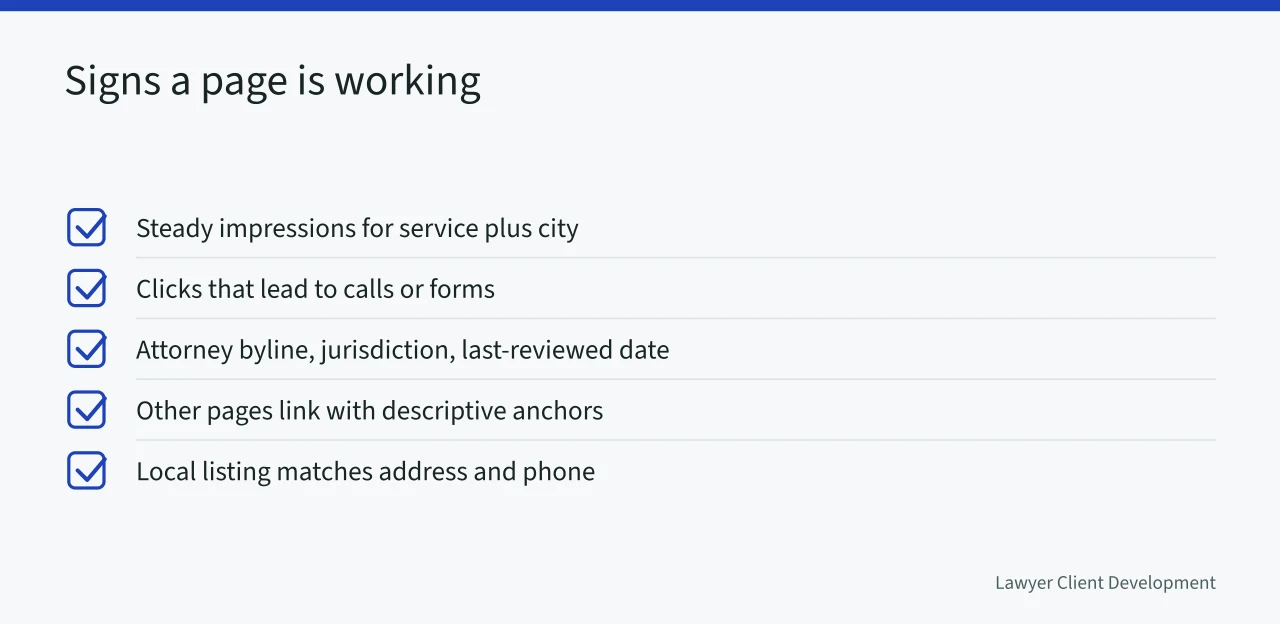
- It holds steady impressions for a core service query plus a city, such as "employment lawyer Sacramento."
- It earns clicks from people who then call or submit a form.
- It carries an attorney byline, a jurisdiction, and a last-reviewed date.
- Other pages link to it with descriptive anchors.
- Its local listing matches the address and phone on the page.
For comparisons of what to keep and what to drop, see law firm marketing strategy case studies.
If a page shows three or more of these, treat it as a protected asset. Copy its title pattern, heading order, and internal links as your template.
Repair the legal-specific signals
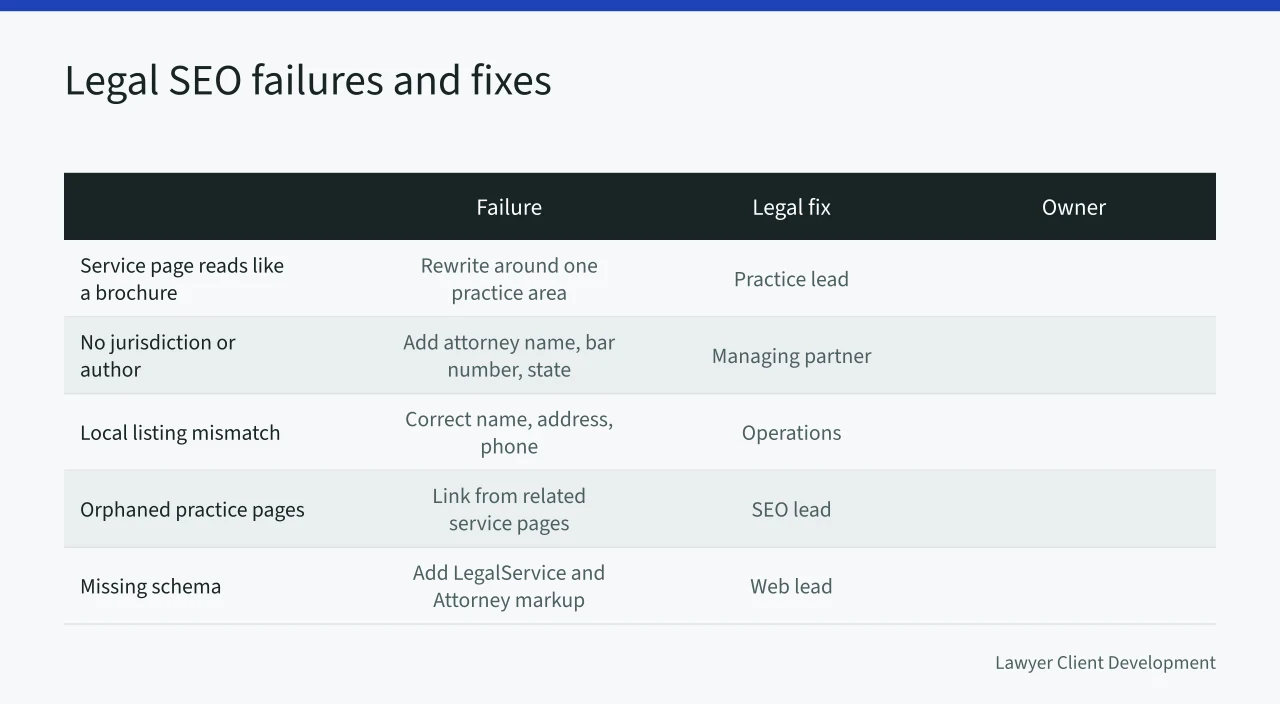
Replace generic checks with legal actions. The table below pairs each failure with the fix and the person who owns it.
| Failure | Legal fix | Owner |
|---|---|---|
| Service page reads like a brochure | Rewrite around one practice area and one client problem | Practice lead |
| No jurisdiction or author | Add attorney name, bar number, and state | Managing partner |
| Local listing mismatch | Correct name, address, and phone on Google Business Profile and directories | Operations |
| Orphaned practice pages | Link from related service and location pages | SEO lead |
| Missing schema | Add LegalService and Attorney markup | Web lead |
Accessibility is part of the access test for legal sites. The U.S. Department of Justice explains its web guidance under the ADA, and that guidance applies to how a firm presents services online. ADA web guidance The client-access-first framing in building a law firm marketing strategy explains why signed cases, not page count, set the target.
Content rules also shape what you can publish. California's Rules of Professional Conduct limit claims and solicitation, so a repair that adds "best lawyer" language can create a bar problem even if rankings rise. California Rules of Professional Conduct
Bar rules vary by state. A repair plan should list the jurisdiction for each page.
For local visibility, Google Local Services Ads use pay-per-lead pricing and verification. A firm that ignores that channel loses calls to competitors who do not. Google Local Services Ads
A repair that adds pages without a clear practice-area purpose adds crawl work and dilutes internal links. Start with the pages that already earn calls.
Protect what ranks before you change anything
Write a baseline before you edit a template, title, or URL. Record impressions, clicks, and calls per page for at least 90 days. Without the baseline, a later drop becomes a story, not evidence. The guide to law firm marketing strategy benchmarks shows how to read ranges and outliers.
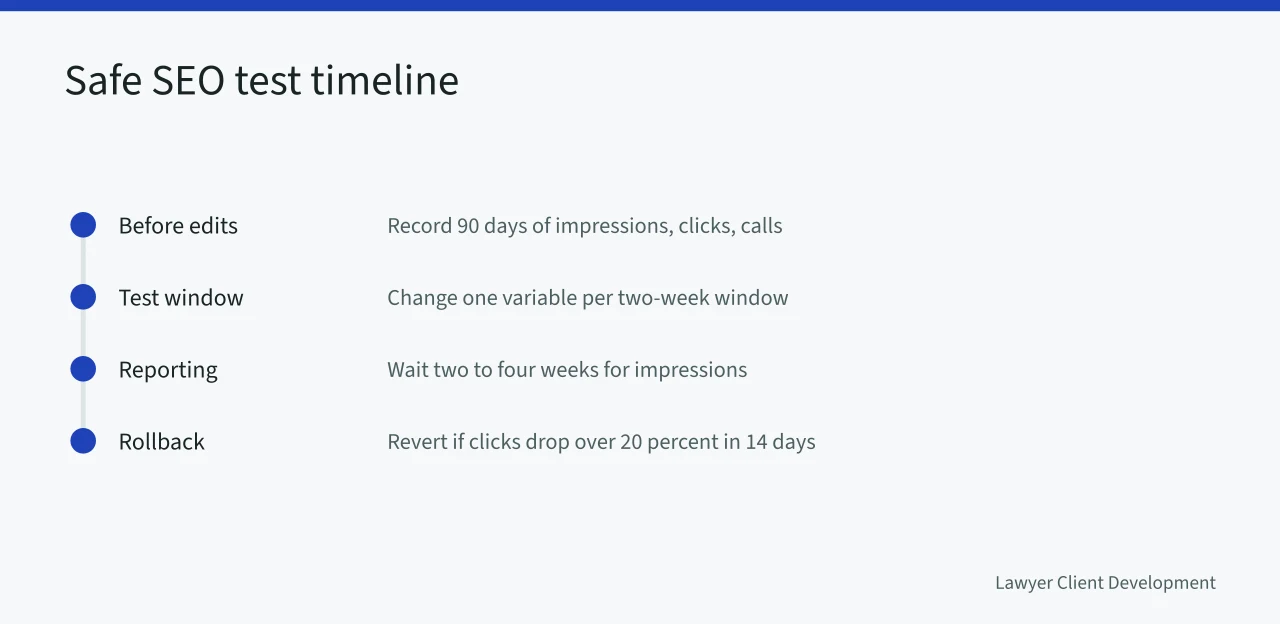
Then change one variable per test group. Keep a control group of similar pages you do not touch. Wait for reporting to mature, usually two to four weeks for impressions and longer for intake.
Set rollback rules in advance. If a protected page loses more than a typical 20 percent of clicks in 14 days, revert the change and note the cause. A typical range for a safe test is one variable per two-week window.
A bad migration looks like this: URLs change, redirects point to the homepage, and core service pages lose impressions on city plus practice queries. Recovery can take months.
Example: consolidating overlapping practice-area pages
A firm had three pages for "estate planning lawyer": one for wills, one for trusts, and one for probate. All three ranked on page two for the same query. The overlap split links and confused the byline.
The firm kept the trusts page, merged the wills content into it, and redirected the probate page to a new probate page. It updated internal links and the local listing.
In a typical case, the merged page gained a 30 to 50 percent lift in impressions within eight weeks. The redirect passed most link equity, and calls from the practice area held steady.
Local listings were part of the repair. The state-by-state guide to Google Local Services Ads for lawyers state by state explains how verification rules change by market.